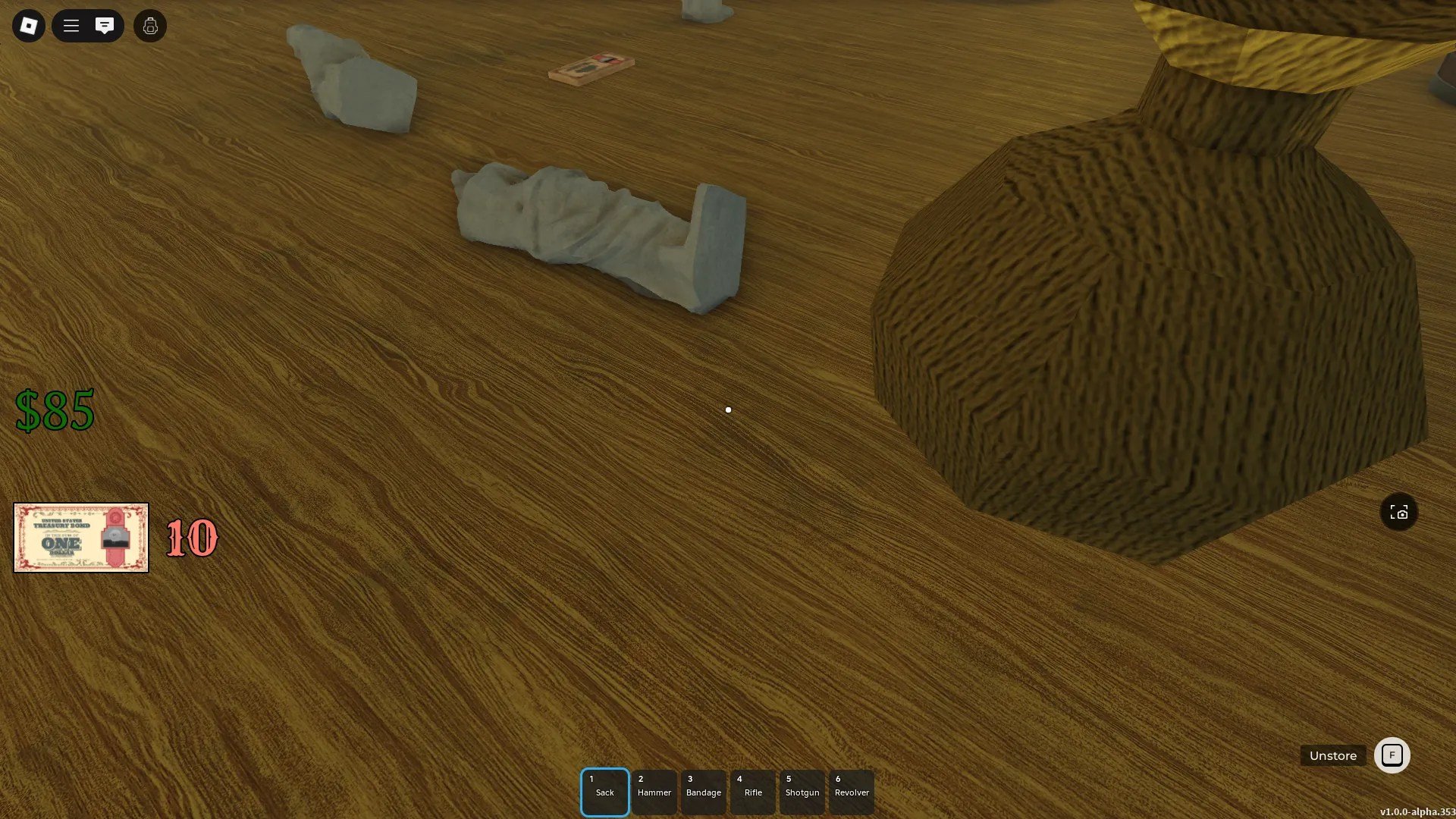
당신이 Dead Rails의 마지막 체크포인트에서 성공적으로 추출하는 것을 목표로 하고 있다면, 철저한 준비가 필수적입니다. 여정 중에 채권을 수집하는 것은 모험을 시작하기 전에 귀중한 아이템을 비축하는 데 중요한 역할을 합니다. 이 목표를 이루기 위해, Dead Rails에서 채권을 수집하는 방법에 대한 포괄적인 가이드를 작성했습니다.
Dead Rails에서 채권을 수집하는 방법

Dead Rails에서 채권을 수집하려면, 다양한 장소에서 E 키를 사용하여 수집해야 합니다. 일반적인 위치로는 은행 금고 안과 40km 이정표에 위치한 성이 있습니다. 가끔 유기된 집에서도 채권을 찾을 수 있지만, 이는 상당히 드뭅니다. 또한 80km 지점의 멕시코 다리로 이어지는 마지막 요새 내부에도 채권이 있지만, 그 지역은 범죄자들이 격렬하게 방어하니 주의하세요.
Dead Rails에서 은행 금고에 접근하는 방법

은행은 모험 중에 거의 모든 불타는 좀비로 가득 찬 마을에서 찾을 수 있습니다. Dead Rails의 각 은행에는 다양한 귀중품과 몇 개의 채권이 포함된 금고가 있습니다. 이 금고에 접근하려면, 금고를 잠금 해제할 코드가 필요하거나 다이너마이트로 부수어야 합니다. 다이너마이트는 요새 내 특정 잡화점에서 구매할 수 있습니다. 금고 문 근처에 다이너마이트를 설치하고, 뒤로 물러서서 발포하여 들어갈 수 있습니다.

금고 코드를 얻으려면 검은 모자를 쓴 좀비를 찾고 처치하세요. 이 좀비가 떨어뜨리는 코드를 수집하고 가장 가까운 은행으로 가세요. 금고에는 손잡이마다 숫자가 표시된 회전 기계가 있습니다. 코드를 입력하려면, M1을 누르고 다른 아이템은 들지 않은 채로 손잡이를 회전하여 첫 번째 숫자가 금고의 맨 위와 일치하도록 합니다. 모든 숫자에 대해 이 작업을 반복하여 금고를 성공적으로 잠금 해제할 수 있습니다.
채권 없이 Dead Rails의 메인 로비에서 금고 여는 연습을 할 수 있습니다. 은행 로비로 가서 금고 기계를 비틀면 익숙해질 수 있습니다.
40km 지점의 성에서 채권 찾는 법
다행히도 일부 적들은 성의 입구에 걸려 있을 수 있습니다, 그럼으로써 안전하게 처치할 수 있습니다. 대부분의 적이 제거될 때까지 성 깊숙이 들어가지 마세요. 최대한의 이익을 위해 인벤토리가 가득 차면 늑대인간과 뱀파이어의 시체를 판매하세요.
마지막 적이 나타난 후에는 성에 자유롭게 들어가서 철저히 약탈하세요. Dead Rails 성에서는 채권, 무기, 탄약, 금 및 은 바 뿐만 아니라 독특한 뱀파이어 나이프도 발견할 수 있습니다.
Dead Rails에서 채권을 사용할 곳

당신은 Dead Rails의 메인 로비에서 잡화점, 총기점, 의사 건물에서 채권을 사용할 수 있습니다. 각 상점은 당신의 경로를 따라 10km마다 있는 요새와 유사한 아이템을 제공합니다. 채권으로 구입한 아이템은 영구적이지 않다는 점을 기억하세요. 아이템들은 죽을 때까지 인벤토리에 남아 있으며, 일반 인벤토리 아이템과 유사합니다.
이것이 Dead Rails에서 채권을 수집하는 것에 대해 알아야 할 모든 것입니다. 이상적인 무기를 찾는 데 어려움을 겪고 계신가요? 더 많은 정보를 원하시면 우리의 Dead Rails 무기 등급 목록을 확인하세요.
자주 묻는 질문 (FAQ)
Dead Rails에서 채권이란 무엇이며 어떻게 작동하나요?
채권은 Dead Rails에서 수집 가능한 아이템으로, 플레이어가 무기, 탄약, 및 기타 귀중한 자원을 획득할 수 있게 해줍니다. 당신은 게임 내 다양한 위치를 탐색하고 적을 처치하여 이들을 수집할 수 있습니다.
Dead Rails에서 은행 금고는 어디에서 찾을 수 있나요?
은행 금고는 화염에 휩싸인 좀비가 가득한 마을에서 흔히 찾아볼 수 있습니다. 여행 중 은행을 찾아 금고에 접근하여 채권 및 기타 아이템을 얻으세요.
Dead Rails에서 은행 금고를 어떻게 잠금 해제하나요?
은행 금고는 검은 모자를 쓴 좀비를 처치하여 금고 코드를 찾거나, 금고 문을 부수기 위해 다이너마이트를 구입하여 잠금을 해제할 수 있습니다. 각 방법을 사용하는 데 대한 지침을 따라주세요.
Dead Rails에서 채권으로 어떤 아이템을 구입할 수 있나요?
Dead Rails에서는 잡화점, 총기점, 및 의사 건물에서 채권으로 아이템을 구입할 수 있습니다. 이 아이템에는 무기, 탄약 및 건강 보조 용품이 포함됩니다.
우리의 활동을 지원해주세요 ❤️
이 글이 마음에 드셨다면, 앞으로도 좋은 콘텐츠를 계속 발행할 수 있도록 팁을 남겨주세요.


![데드 레일즈에서 채권을 얻는 궁극적인 안내서 [알파] 에디션](https://kr.moyens.net/wp-content/uploads/2025/05/1746220199_데드-레일즈에서-채권을-얻는-궁극적인-안내서-알파-에디션.webp-1600x900.jpeg)


![THINK: The user wants to translate the title "Catch a Brainrot Tier List & Guide (RELEASE)" into Korean. I need to break down the key terms and concepts in the English title and find their appropriate Korean equivalents.
Catch a Brainrot: This is a playful, internet slang phrase.
"Brainrot" (뇌절) is a common internet slang in Korean, referring to something so cringey, overdone, or nonsensical that it makes your brain "rot" or shut down. It can also mean obsessing over something to an unhealthy degree.
"Catch a Brainrot" could be interpreted as "falling into brainrot," "getting brainrot," or simply "experiencing brainrot."
A common way to express "getting into / falling into [something bad/annoying/overdone]" in Korean internet slang is by using the noun and then implying the action. For example, "뇌절" itself can be used. Or, one might say "뇌절 각" (a situation ripe for brainrot), or "뇌절 유발" (brainrot-inducing).
However, "Catch a Brainrot" here seems to be the topic of the tier list. The tier list is about brainrot. So, maybe just referring to "brainrot" is enough.
Let's consider the nuance. "Catch a Brainrot" implies an action or a state. A tier list for brainrot items/situations.
Perhaps something like "뇌절 요소" (brainrot elements/factors) or "뇌절 유형" (brainrot types).
Or, simply using "뇌절" as the core concept.
If it's about identifying and categorizing different "brainrot" things, then "뇌절" as a concept is central.
"Catch a Brainrot" can be a bit tricky. Does it mean "how to get brainrot" or "how to identify brainrot"? Given the "Tier List & Guide," it's more likely about identifying and navigating different types of brainrot.
Let's try to capture the "catch" part. If it's about identifying or understanding brainrot.
"뇌절" is the direct translation for brainrot.
"잡다" (japda) means "to catch," but "뇌절을 잡다" doesn't sound natural in this context.
"뇌절에 대한" (about brainrot) or "뇌절 알아보기" (understanding brainrot).
Considering "Catch a Brainrot" as a playful, informal title, a direct translation might lose the feel.
Let's focus on what the tier list is. It's a tier list of brainrot-inducing things or brainrot situations. So the focus is on "brainrot."
Just "뇌절" might be sufficient as the object of the list.
Tier List: "티어 목록" (tieo mongnok) or "티어 리스트" (tieo riseuteu) are common. "등급표" (deunggeuppyo) is also possible for "tier list" or "ranking chart." "티어표" (tieopyo) is very common internet slang. "티어표" fits the informal tone better.
& Guide: "&" is often translated as "및" (mit), "그리고" (geurigo), or just omitted and implied by context. "Guide" is "가이드" (gaideu) or "안내서" (annaeseo). "가이드" is more common in such contexts.
(RELEASE): "(출시)" (chulsi), "(공개)" (gonggae), or "(발매)" (balmae). "(출시)" or "(공개)" are suitable for a content release. "(공개)" is perhaps more general for a release of information/content.
Combining them:
Option 1 (Focus on "brainrot" as the subject):
뇌절 티어표 & 가이드 (공개)
(Noejjeol tieopyo & gaideu (gonggae))
Option 2 (Trying to keep "catch"):
Is there a way to say "spotting brainrot" or "understanding brainrot" in a concise, slangy way?
"뇌절 잡기" (noejjeol japgi) - "catching brainrot," but again, "잡기" sounds like a game or a physical action.
"뇌절 포착" (noejjeol pochak) - "detecting/spotting brainrot," but "포착" is a bit too formal.
"뇌절 알아보기" (noejjeol arabogi) - "getting to know brainrot," "learning about brainrot."
"뇌절 공략" (noejjeol gongnyak) - "brainrot strategy/guide," implies how to deal with/understand brainrot. This is often used for game guides. This could fit "Catch a Brainrot Tier List & Guide."
Let's reconsider "Catch a Brainrot." If it's a guide for catching brainrot elements, then "뇌절 공략" or "뇌절 가이드" directly fits the "Guide" part.
The title is "Catch a Brainrot Tier List & Guide."
This implies the Tier List is about catching/understanding brainrot.
Let's break "Catch a Brainrot Tier List" as "뇌절 티어표." This means a tier list of brainrot.
Then "Guide" is just "가이드."
So, "뇌절 티어표 & 가이드" (Noejjeol tieopyo & gaideu) seems the most natural and concise translation for "Brainrot Tier List & Guide."
What about "Catch a"?
If the original was "How to Catch Brainrot: A Tier List & Guide," then "뇌절 잡는 법: 티어표 및 가이드" would be appropriate.
But it's "Catch a Brainrot Tier List & Guide." This phrasing suggests the tier list itself is a "catch a brainrot" type of list. It's almost like a category.
Perhaps "뇌절 캐치" (noejjeol kaechi - brainrot catch) could be integrated.
"뇌절 캐치 티어표 & 가이드" (Noejjeol kaechi tieopyo & gaideu)
"캐치" (kaechi) as in English "catch" is sometimes used for "catching on," "spotting," or "grabbing attention." This could work.
Let's compare:
뇌절 티어표 & 가이드 (공개) - Very direct, concise. "Brainrot Tier List & Guide (Release)." This implicitly covers "Catch a Brainrot" by making "brainrot" the subject of the list/guide.
뇌절 캐치 티어표 & 가이드 (공개) - Adds "캐치" which directly translates "Catch" and fits the informal tone. "Brainrot Catch Tier List & Guide (Release)." This explicitly states it's about catching or identifying brainrot.
Given the playful nature of "Catch a Brainrot," "뇌절 캐치" feels a bit more aligned with the original's intent of "spotting" or "identifying" brainrot items/situations. "캐치" is often used in Korean slang for "catching a glimpse," "catching on," or "spotting something."
Let's try to verify "뇌절 캐치". "밈 캐치" (meme catch) or similar phrases are used. It makes sense in an internet context.
So, the structure would be:
"Catch a Brainrot" -> 뇌절 캐치
"Tier List" -> 티어표
"& Guide" -> & 가이드
"(RELEASE)" -> (공개)
Putting it together:
뇌절 캐치 티어표 & 가이드 (공개)
Final check for plain text requirement:
"Return only the translated title as plain text. Do not include any explanations, additional text, formatting, or extra punctuation."
The chosen translation is "뇌절 캐치 티어표 & 가이드 (공개)". This fits all requirements.뇌절 캐치 티어표 & 가이드 (공개)](https://kr.moyens.net/wp-content/uploads/2026/07/1783863662_THINK-The-user-wants-to-translate-the-title-Catch-a-280x210.jpg)

![THOUGHT: The user wants to translate a title into Korean.
The title is "Haze Seas: Trello, Wiki & Discord Resources".
I need to break down the title into its components and translate each part.
Haze Seas: This sounds like a proper noun, possibly the name of a game, project, or community.
"Haze" can be translated as 안개 (an-gae).
"Seas" can be translated as 바다 (ba-da).
So, "Haze Seas" could be 안개 바다. If it's a fantasy name, sometimes direct translation works.
: (colon) - This is a separator, often kept as is or sometimes replaced by another connector in Korean if the flow requires it, but usually, a direct colon is fine, or contextually implied. However, the request specifically asks for plain text and no extra punctuation, so I should just translate the words and not add any extra punctuation like a colon if it's not explicitly part of the original word. The colon acts as a separator in the English title, so I should represent the relationship between the first part and the second part directly in Korean without adding a literal colon character in the final output. The instruction "Do not include any explanations, additional text, formatting, or extra punctuation" reinforces this.
Trello, Wiki & Discord Resources: This lists different types of resources.
Trello: This is a specific platform name, usually kept as is in Korean, written in Hangul. 트렐로 (teu-rel-lo).
Wiki: Also a specific platform/concept, usually kept as is in Korean, written in Hangul. 위키 (wi-ki).
&: "and". In Korean, this can be 와/과 (wa/gwa) or 및 (mit) or 그냥 (geu-nyang - just) or an implied 'and' by listing. Given it's a list of resources, '및' (and/as well as) is a good choice for connecting the last item in a list of categories.
Discord: Another platform name, kept as is in Korean, written in Hangul. 디스코드 (di-seu-ko-deu).
Resources: 자원 (ja-won - natural resources), 자료 (ja-ryo - data/material/resources), 리소스 (ri-so-seu - direct transliteration of resource, often used in IT/software contexts). For this context (Trello, Wiki, Discord for a project/community), 자료 or 리소스 would be appropriate. 자료 seems more natural for "information/guide resources".
Let's combine these:
Option 1 (direct translation, with implied colon/connection):
안개 바다: 트렐로, 위키 및 디스코드 자료
(Here, the colon is still present)
The instruction "Return only the translated title as plain text. Do not include any explanations, additional text, formatting, or extra punctuation." suggests I should not include the colon character if possible. I should try to make the Korean flow naturally without it.
Let's re-evaluate the structure without the colon:
"Haze Seas - Trello, Wiki & Discord Resources" implies "Resources for Haze Seas, specifically Trello, Wiki, and Discord ones." or "Haze Seas: These are the Trello, Wiki, and Discord resources related to it."
Korean sentence structure might be: "[Project Name] 관련 [Resource List] 자료" (Related [Resource List] Resources).
So, "[Haze Seas] 관련 트렐로, 위키 및 디스코드 자료"
안개 바다 관련 트렐로, 위키 및 디스코드 자료.
This sounds natural and avoids the colon.
Let's verify the "Haze Seas" translation again. If it's a proper noun, it might be better to transliterate or find a more common usage if it refers to a specific known entity. However, without more context, "안개 바다" (Fog Sea / Haze Sea) is a direct and reasonable translation for a name like "Haze Seas."
Let's consider "리소스" vs "자료". "리소스" is a direct transliteration and commonly used in IT/game contexts for "resources." "자료" is more general for "data/materials/information." Given Trello, Wiki, Discord are tools for managing information/materials, both work. "자료" might feel slightly more natural for "information resources" in a general sense. However, "리소스" is perfectly acceptable and often used. I'll go with 자료 for now.
So, the structure is:
[Project/Community Name] + [Connector for relatedness] + [List of platforms] + [Type of resources].
"Haze Seas" = 안개 바다
"related to" / "for" = 관련 (gwan-ryeon) or 의 (ui - possessive, less common here)
"Trello, Wiki & Discord" = 트렐로, 위키 및 디스코드
"Resources" = 자료
Combining:
안개 바다 관련 트렐로, 위키 및 디스코드 자료
This fits the "plain text" and "no extra punctuation" requirement as it directly translates the meaning without including the English colon.
Final check on the parts:
Haze Seas -> 안개 바다 (An-gae Ba-da)
Trello -> 트렐로 (Teu-rel-lo)
Wiki -> 위키 (Wi-ki)
Discord -> 디스코드 (Di-seu-ko-deu)
& -> 및 (mit - and, as well as)
Resources -> 자료 (ja-ryo - materials, data, resources)
The colon's function is to relate "Haze Seas" to the list of resources. "관련" (gwan-ryeon - related, concerning) serves this function naturally in Korean.
The translation "안개 바다 관련 트렐로, 위키 및 디스코드 자료" seems robust.안개 바다 관련 트렐로, 위키 및 디스코드 자료](https://kr.moyens.net/wp-content/uploads/2026/07/1783230518_THOUGHT-The-user-wants-to-translate-a-title-into-Korean-280x210.jpg)